

The San Juan Situation: Analyzing Hiker Visits on Colorado's Most Popular Peaks
The Colorado Fourteeners Initiative has released its 2025 trail use report, revealing new insights into hiker behavior across the Centennial State.


The Colorado Fourteeners Initiative has just released the 2025 Trail Use Report, which—if you’re not in the know—is one of our most comprehensive dataset we have for tracking hiker behavior. Every year, I break down this data for you, and try to predict how other factors will influence hiker behavior over the coming season.
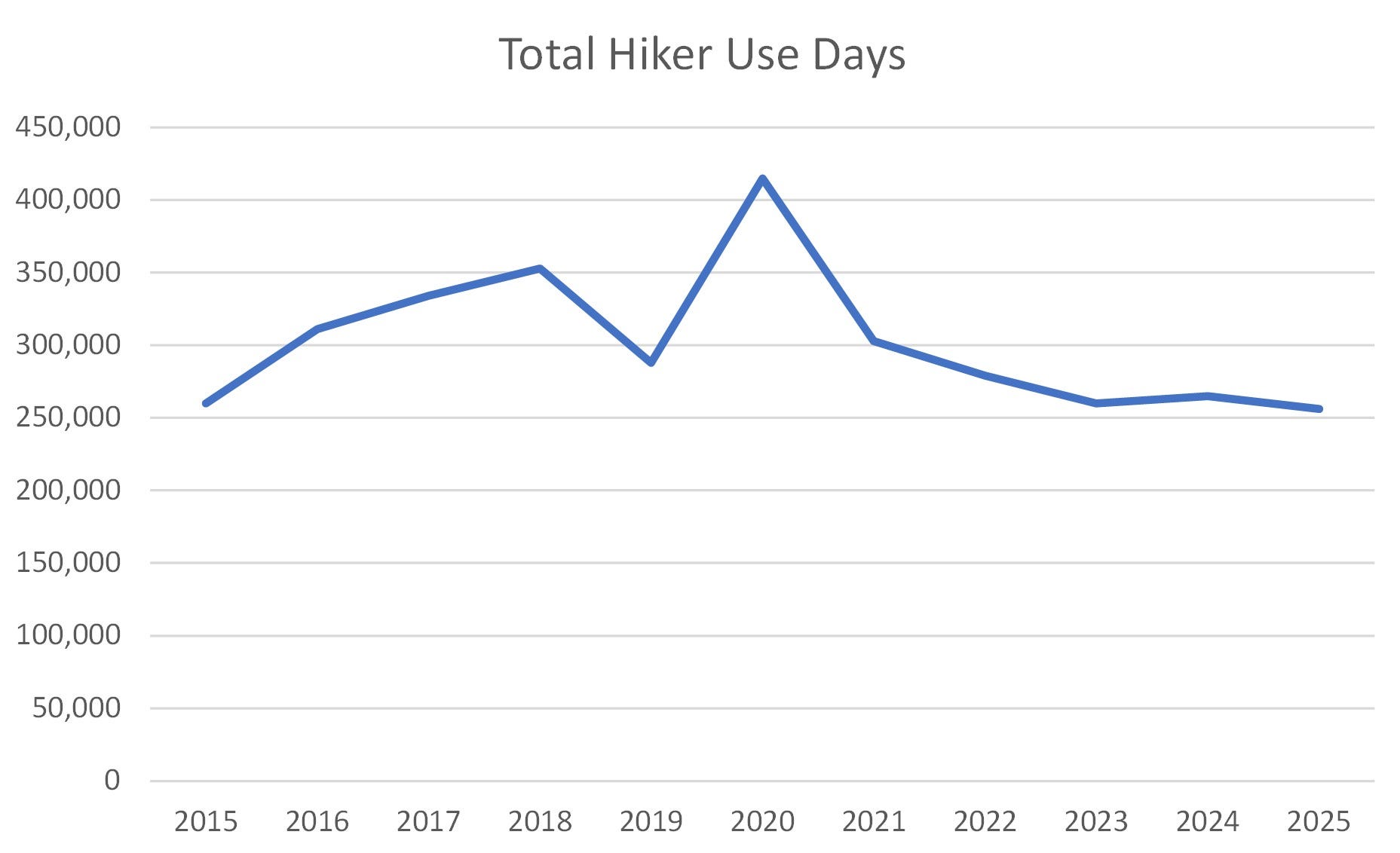
Without further ado, here is the annual graph you’ve all been waiting for:
The Big Picture
Colorado 14er saw fewer hiker use days* in 2025, but because one of the state’s most popular peaks was essentially rendered inaccessible, that means use days elsewhere are actually up. Most of this trend appears to be driven by a resurgence among the usual suspects—popular peakbagger destinations like Quandary, Bierstadt and DeCaLiBron.
*From here on out, I will be referring to Hiker Use Days as HUDs.
The reason we use HUDs instead of visitors, is because it’s impossible to know whether they translate into unique visitors. A single prolific hiker could be responsible for a dozen hiker use days in a given season. Some even climb multiple peaks in one outing.
It’s best to think of this measurement as one person, visiting one trail, on one day.
To complete this article, I’ve boiled down a decade of data into just a few nifty graphs. As always, I want to make the data transparent and available to you. All of the raw numbers can be found below in one convenient PDF:

I’ve also linked my analysis from the past five years, in case you’re curious how my predictions have held up over time.
The Big Five
A few years ago, I predicted as climbing conditions normalized, the most popular 14ers would eventually herd together in terms of visitor numbers. This is somewhat still the case; Quandary and Bierstadt understandably remain tied for first place, due in equal parts to their reputation as “beginner peaks,”1 proximity to the I-70 corridor, and nearby amenities.2
DeCaLiBron continues its upward trajectory, which makes sense given that trail use has essentially been guaranteed after years of inconsistent access. The ability to summit four mountains in a single outing also makes it an attractive destination for peakbaggers.
I would like to wait and see whether this trail’s uptick is sustained, or simply the result of pent up demand.
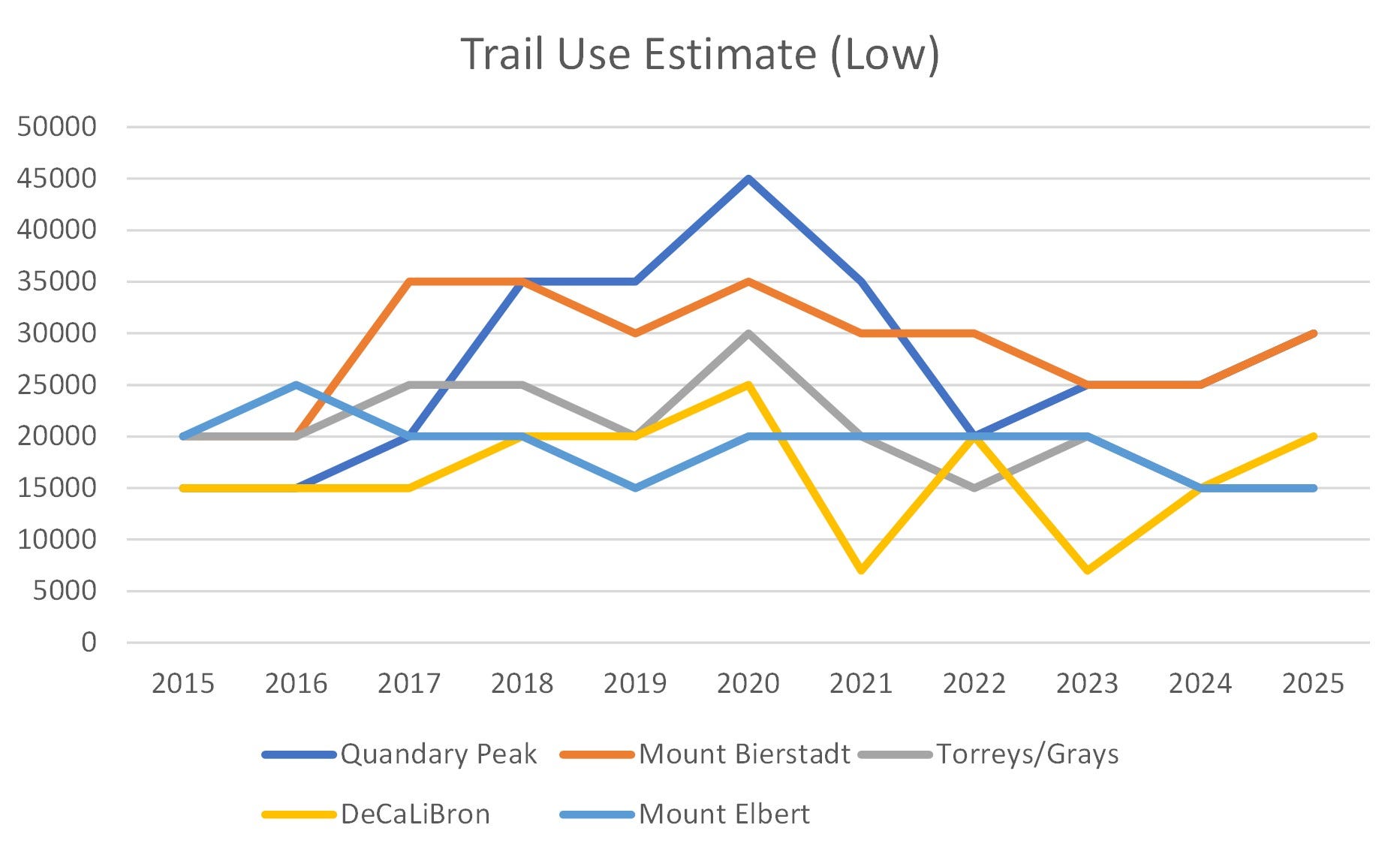
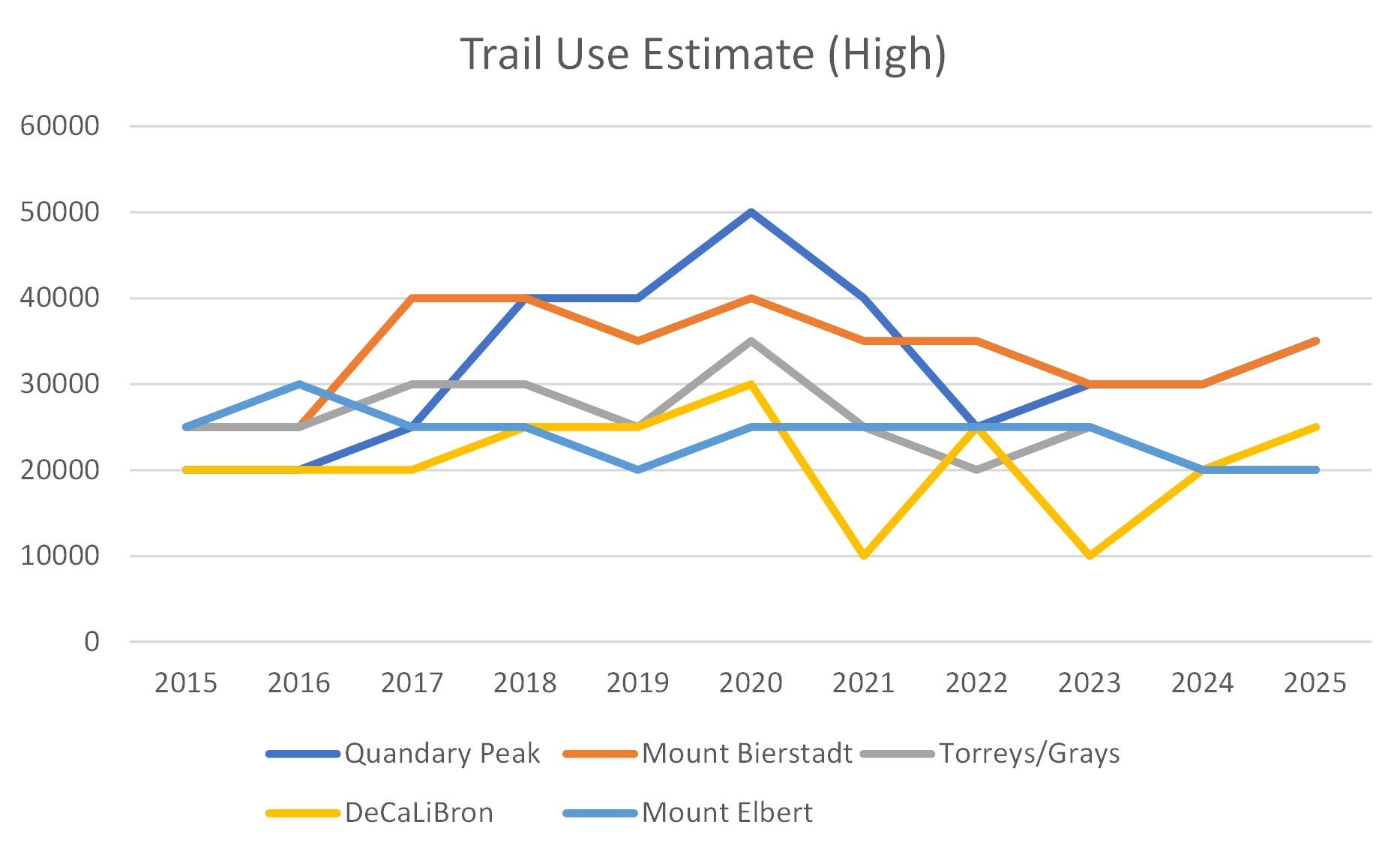
I’m surprised to see Grays and Torreys3 falling to the bottom of the leaderboard, now on par with Elbert. This is somewhat shocking to me, given that Grays and Torreys is also a peakbagger double-feature, much closer to the Denver metro than Elbert.
This could be due to the gnarly road running up Stevens Gulch to the G&T trailhead—then again, I’ve watched more than one driver slice up the undercarriage on their stock sedan on that road; I’m not sure how likely it is that everyone is suddenly doing more research on the parking situation.
Blue Sky Slump
A big confounding variable is Mt. Blue Sky. For the entire 2025 season, the access road was closed for repairs. Because of this, 19,000 HUDs were wiped off the board.
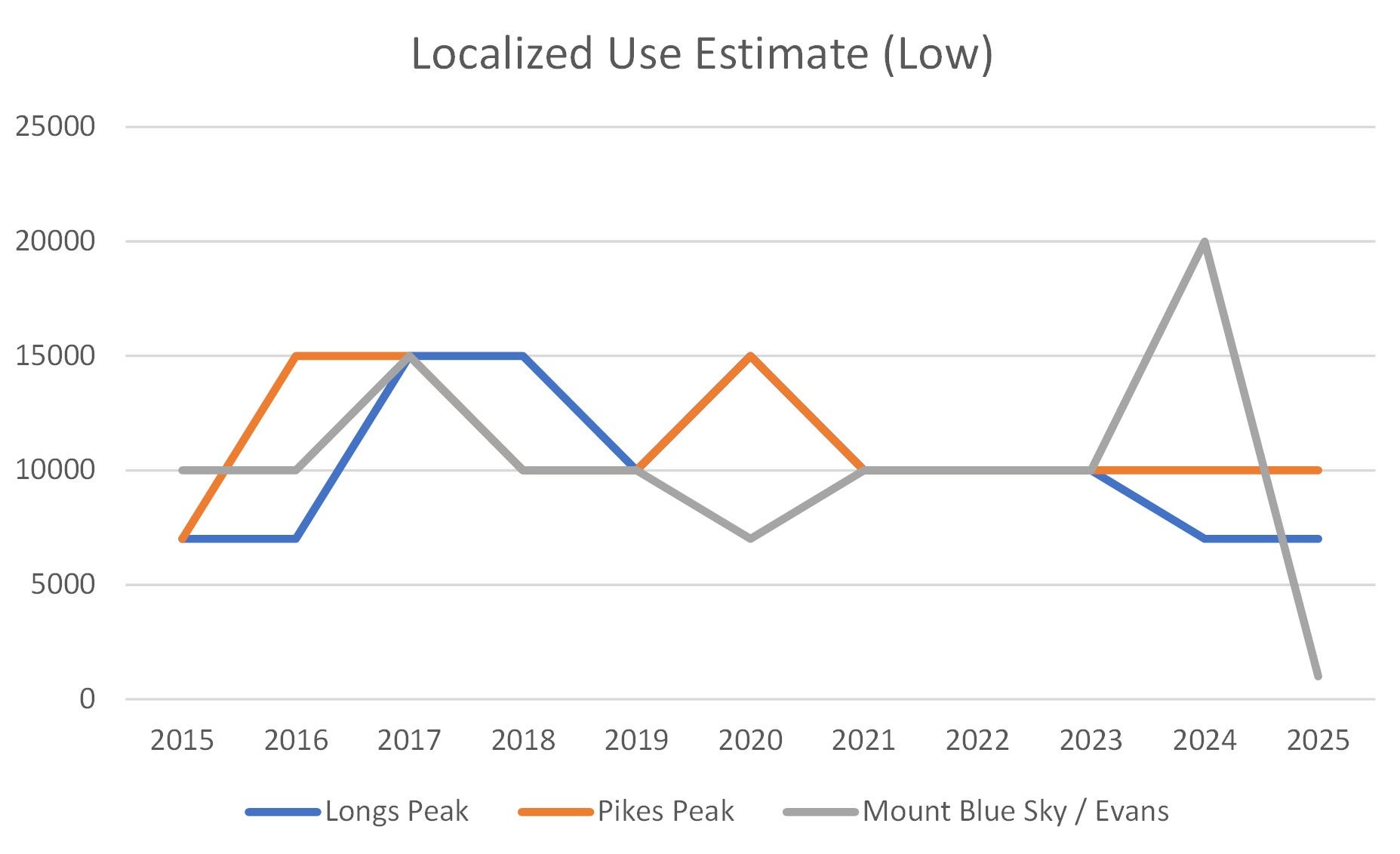
This of course begs the question: if HUDs went down by 19,000 on Blue Sky, but only 9,000 overall, then where were people climbing instead? In 2025, it looks like Quandary, Bierstadt, and the DeCaLiBron loop picked up the lion’s share, gaining about 5,000 HUDs a pop.
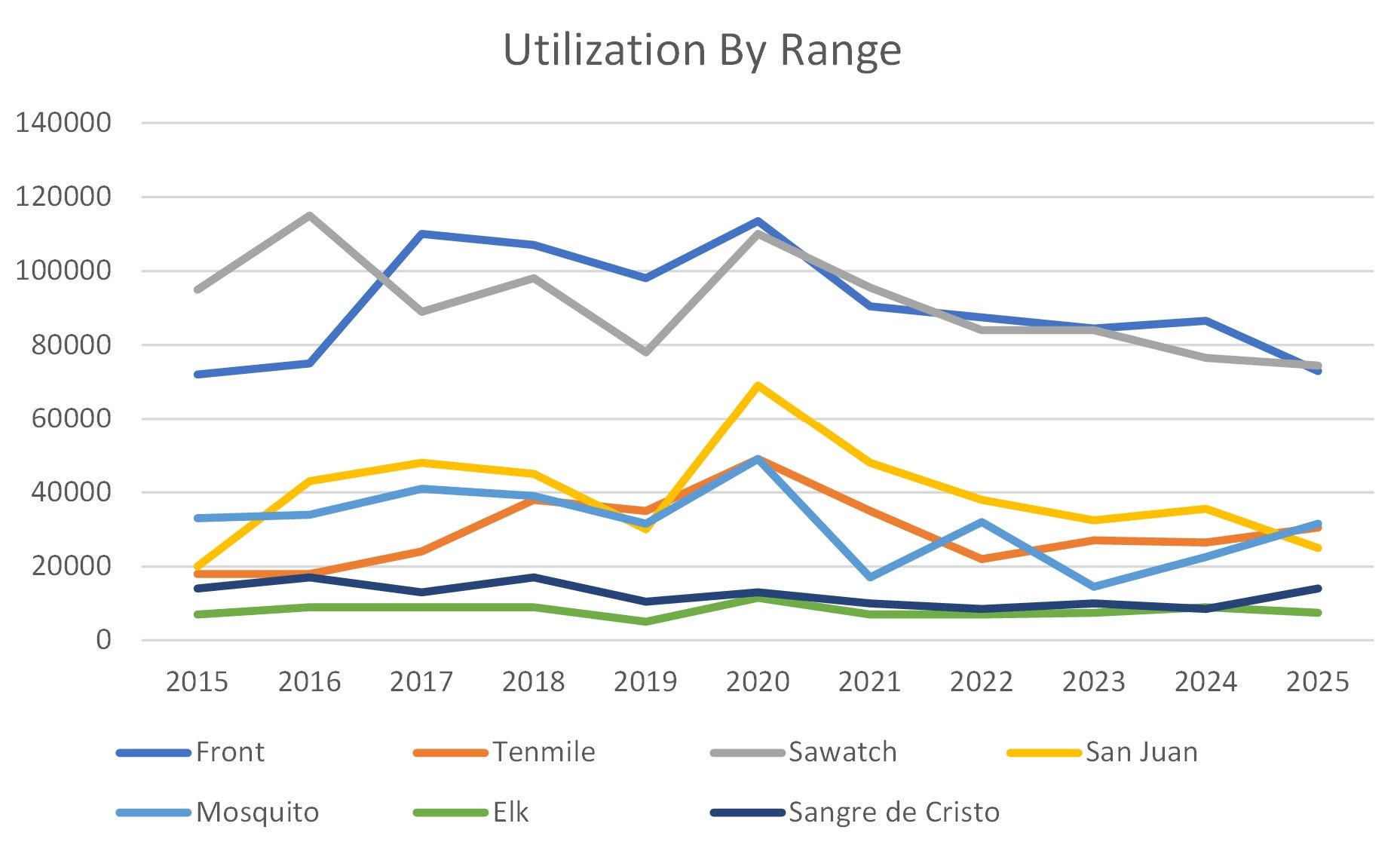
The Tenmile, Mosquito, and Sangre de Cristo ranges also saw modest increases in HUD numbers, while virtually every other mountain range saw decreases.
Last Year’s Questions, Answered
1 — Will Bierstadt drop down?
After the last report, I hypothesized Bierstadt would see fewer visitors as a result of an aggressive crackdown on illegal parking. As I mentioned in the last report: Guanella pass was overdue for parking enforcement, and I had been predicting it would get the Quandary treatment in due time.
Still, Bierstadt’s numbers actually went up. Then again, the increase is in step with the other popular peaks. If I had to guess, I would attribute this particular uptick to the closure of Mt. Blue Sky—Bierstadt’s literal next door neighbor.
2 — San Juan Status Update
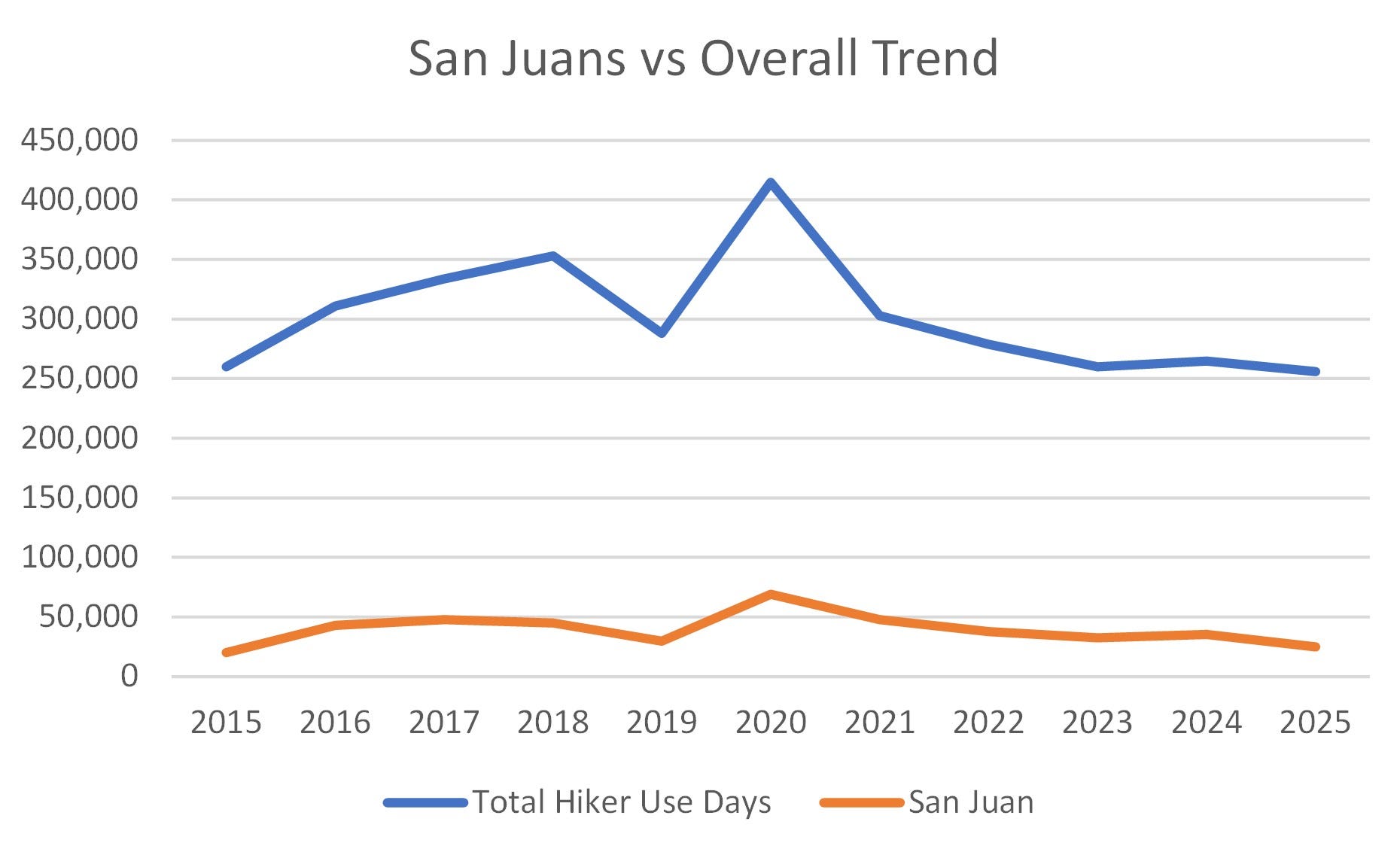
I have taken a particular interest in the San Juans over the past few years, after noticing these peaks tend to chart almost perfectly alongside the overall utilization trend. This continued once again, and with ten years of data on the books, I believe I have enough data to start drawing conclusions.
The cause may turn out to be a somewhat tedious result of methodology.
If you’re new here: CFI uses physical counters to measure foot traffic on some of the peaks, then uses a formula to extrapolate HUD data to other peaks. Twenty counters were deployed in 2025.
My hunch was that, since only two peaks in the San Juans have counters, the formula is much more influenced by the broader hiking trends—namely the front range.
I reached out to Lloyd Athearn, CFI’s Executive Director, who essentially confirmed this to be the case.
“My sense is that when there is more limited data within a particular range, the modeling program is more influenced by places where it does have data—in this case the more numerous and higher level counters in the Front-ish ranges. As I point out, a higher percentage of statewide use was on Front/Tenmile/Mosquito/Elbert than in the prior year.”
—Lloyd Athearn, CFI’s Executive Director
All of this to say: the San Juans were tracking almost perfectly with the statewide trend, but as a result of data methodology. This range is not some kind of mystery bellwether for overall hiker behavior.
Darn.
At some point, I will try to do a serious deep dive about how CFI arrives at their numbers because I think the process is fascinating, but I digress.
Speaking of Quirks in the Data…
The 2026 report will be the big one to watch, because it has the potential to resolve a years-long mystery surrounding the visitor numbers on Mount Blue Sky.
This came up when I was interviewing Athearn for my appearance on 9News, where I discussed the impact of low snowpack on trail building.
Athearn mentioned that the formula used to calculate visitors to Mt. Blue Sky may have been operating on flawed assumptions, essentially causing a massive under-count of visitors. Here’s the excerpt from our interview:
“Well, if you’re assuming that someone’s doing a route that’s like 20 plus miles from Echo Lake, I mean, it’s a real long haul. I’ve done that climb the mountain from there, and it’s a long trip. Whereas most people are probably driving into Summit Lake and doing a much shorter climb,” Athearn said. “When we realized that, ‘oh, that little formula might be wrong for this peak,’ then all of a sudden, it shot up dramatically. So that might be overestimating it too. We’ll find out.”
In other words: the model assumed hikers were taking the Echo Lake route, which probably led to an undercount based purely on the trail’s length. CFI attempted to correct this by running the numbers for Summit Lake Instead.
This formula was tweaked for the 2024 dataset, which led to a huge uptick in the HUD count. The radical spike led CFI to install an actual counter on the trail for the 2026 season, which means next year’s report could radically change our interpretation of the numbers.
WARNING: the idea of a “beginner peak” is relative. All 14ers can be dangerous, particularly to underprepared hikers
Quandary being within easy driving distance of Breckenridge, while Bierstadt is in roughly the same proximity to Georgetown.
Grays and Torreys (shown in gray) is now charting perfectly alongside Mt. Elbert (shown in light blue). Similarly, Quandary Peak (shown in dark blue) is now obscured by Bierstadt’s line (orange).