


After spending several years studying and reporting on the Colorado Outdoors, I have made my on-air debut on 9News. I’m thrilled to have had the chance to share this information with a broader audience.
The broadcast version of this story is attached above if you’d like to watch. The written version appears below.
Colorado is coming off of a historic snow slump, clocking in at just 17% of the median snowpack. Despite a mid-May storm, this season might be the most scant in state history—at least in terms of peak snowpack.
The impact on the winter sports season has been dismal, and the lack of moisture could carry over into the hiking season as well.
“That’s Unheard Of”
Normally, lingering snowpack obstructs the routes to these peaks, leaving them inaccessible to all but the most experienced hikers until late spring or early summer. But this season, that’s simply not the case.
Lloyd Athearn is the Executive Director of the Colorado Fourteeners Initiative; the group tasked with building and maintaining some of the state’s tallest and most popular trails.
This season, he says access has opened up months earlier than usual.
“There's just nothing up there. I've been up on some of these mountains getting trail counters out early because conditions have allowed, and we're essentially six weeks to two months earlier than we would normally have,” Athearn said. “I was up and putting a counter on Gray's peak that we normally don't get in until the last week of May or the first week of June, sometimes into the second or third week of June. I was up there in the first week of April, and that's because the road was clear and the hiking trail was almost exclusively free of snow—just a few lingering snow patches, and that's unheard of.”
There is correlation between late season snowpack, and Hiker Use Days. Take for example the 2019 season, which saw one of the state’s highest snowpacks of all time. The year also bucked a multi-year visitor growth trend by giving hikers a much shorter effective summiting season.
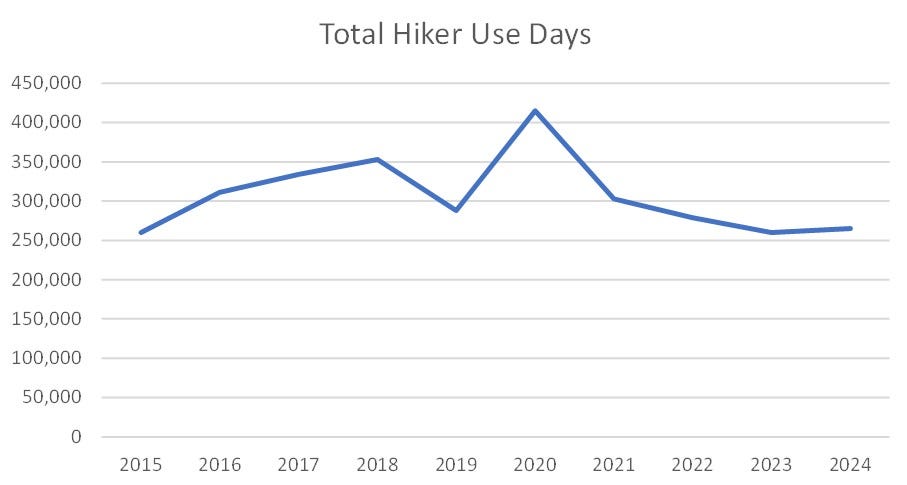
By the way—for a full breakdown, check out this article analyzing trail access data from the Colorado Fourteeners Initiative.
You’d be forgiven for thinking a long hiking season means trail builders will have extra time to work on their ongoing improvement projects. But you would be mistaken.
In fact, this could shape up to be a difficult and expensive year for CFI.
This is for a few reasons, first among them being labor. CFI utilizes seasonal workers to staff what it calls “fixed crews.” These groups operate out of semi-permanent sites, rotating out every week or so for time off.
“They're packing in camps in in the first week or so of June… We usually disband and debrief around the first of October. That’s that’s set year to year, and that’s the way our hiring system is based on” Athearn explained. “We don't necessarily have the crews available to start working now and again. We just have to deal with whatever Mother Nature throws our way.”
The Water Problem
The second complication is provisioning these sites. Breaking rocks and building trails is thirsty work, and water is heavy—so heavy you can’t realistically have everyone carrying in their own drinking water for the week.
In case you don’t believe me, here’s some quick napkin math:
Let’s say you only consumer 3 Liters of water per day, or about 3 typical Nalgene bottles. This is a massive underestimate by the way, which would probably leave you severely dehydrated while doing serious work. It also presumes you aren’t using any water for cooking.
Each of those bottles weighs about 2.2 Lbs..
That works out to 6.6 Lbs. of water per day, and 52.8 Lbs. per trip, since crews work in 8 day stints.
That’s on top of the other gear you need to bring—tools, clothes, food, etc. It’s simply an unsustainable amount of weight to haul in.
Instead, CFI planned to supply its Mt. Shavano crews with water from a snowmelt stream. If that stream runs dry from the historic lack of snowpack, the crews will need to find another source of water. Due to the remote location of the work sites, that may be challenging.
“It's a little harder if you've built the facility for your team to work out of for four months, and then that becomes unsustainable,” Athearn said. “That's where it's more likely that we try to figure out some way of flowing flying in giant water containers with a helicopter.”
Airlifting hundreds of pounds of water per week to remote locations can quickly get expensive, and logistically challenging to manage—and that’s assuming trail crews aren’t forced to contend with another, more dangerous issue.
The Fire Problem
Dry winters can set up the state for serious wildfire risks during summer months. A wildfire doesn’t have to burn near the worksites to be disruptive, either. Hazardous smoke travels quite far, and can make for unsafe working conditions for these crews.
‘We've had to move crews from projects because they're either closing down the whole forest, or there's too much smoke to make it healthy for people to be working,” Athearn said. “People always talk about raining raising rainy day funds for us, it's the smoky day fund. So we've been trying to build our reserves, knowing that there would be a year where we would have very significant fire and smoke impacts, and might have to be very adaptive in moving people throughout the state from places where they're supposed to be working to places where there's still work to be done.”
The fire problem goes hand-in-hand with another challenge: funding. In case you missed it: Athearn hits on a specific snag with the way CFI raises money. A lot of funding is allocated for specific people, on specific peaks. In other words: money raised for work on Mt. Shavano can’t be spent on Mt. Elbert.
If one of these fixed sites is disrupted—either by fire danger or lack of potable water—CFI will have to either have the impacted crews sit idle, or dip into funding reserves to pay for work on other sites.
If you would like to help keep these reserves topped off so that CFI’s work can continue uninterrupted, here is a link to the organization’s donation page.
Super El Niño
There has also been a lot of talk about a potential Super El Niño forming, which would have the potential to bring a lot of moisture to the drought-afflicted state. However, the same storms that could end the drought could also bring lightning—a less-than-ideal prospect in Colorado’s current tinderbox state.
There could be a high-risk window in which the region hasn’t received quite enough water to end the drought, but must endure serious thunderstorms.
The other problem with big bursts of rain is that they can create a kind of rebound effect. A hefty snowpack is a great defense against wildfires, because it’s essentially a time-release watering system. Wildlife stays hydrated through gradual melting. But it never gets quite enough water to trigger rampant overgrowth.
In these boom-bust storms, plants can go through cycles of growing and drying out, potentially creating even more fuel for wildfires.
But as is the case for our annual hiker trends, we will just have to wait and see what the season brings.
Thanks for reading. If you found this update to be interesting, consider sharing this post with a fellow hiker or friend.

